
Youth & Family Support
Therapeutic Mentoring
“Focus on strength, not labels. What we focus on becomes reality.”

What Is Therapeutic Mentoring?
Therapeutic Mentoring is a structured, one-to-one, strength-based support service that pairs a trained therapeutic mentor with a young person up to age 21. Together they work on the skills that shape daily life — communicating clearly, managing emotions, navigating relationships, handling conflict, and building toward independence.
What sets this service apart is where it happens. We do not ask families to come to us. Mentoring is delivered in the settings where a young person actually lives their life: the family home, a foster or therapeutic foster placement, school, childcare, respite settings, and other community environments where the youth is already known and comfortable.
Skills learned in an office tend to stay in the office. Skills learned at the kitchen table, on the walk home, or in the middle of a hard afternoon are the ones that hold.
What Is Therapeutic Mentor?
A therapeutic mentor is a positive adult role model, selected specifically for the ability to connect with young people and to hold high expectations without judgment.
Our mentors serve as a bridge between a young person and their community. They work to increase positive social behavior, reduce involvement with the legal system, and help youth become more connected, more curious, and more responsible members of the places they belong to.
Effective mentoring requires seeing the whole picture. Behavior does not happen in a vacuum — it is shaped by factors inside the individual, the family, the school, and the neighborhood. Decades of research on resilience, the capacity to thrive in unpromising circumstances, have identified protective factors at each of those levels that measurably reduce the risk of delinquency, substance use, school dropout, and violence.
Our mentors are trained to find those protective factors, strengthen them, and help build the positive support networks that make resilience durable rather than temporary.
We serve children, adolescents, and young parents who need additional support in the home and in the community.
How It Works
Services include, but are not limited to:
-
Coaching, support, and training in age-appropriate behavior
-
Interpersonal communication, conflict resolution, and problem-solving
-
Relating appropriately to peers and adults in social and recreational settings
-
Psychosocial skill training — communication, problem-solving, anger management, and relapse prevention among them
-
Ongoing progress monitoring, including motivational interviewing
-
Relationship-building and repair between the adolescent and their caregiver
-
Coping and self-management strategies the youth can use independently
-
Structured leisure and recreational activities designed around the young person's own interests, creating genuine opportunities to practice social and coping skills
-
In-person and telephone contact to sustain engagement and encourage participation in mutual support groups and other services
-
Development, review, and ongoing updating of Wellness and Recovery Action Plans
-
Linkage to community-based recovery supports, activities, and wellness resources
-
Help identifying needed services and navigating social service systems
-
Advocacy and liaison support where needed — including court hearings, child welfare proceedings, and other settings that may provoke a trauma response
-
Transportation to needed services
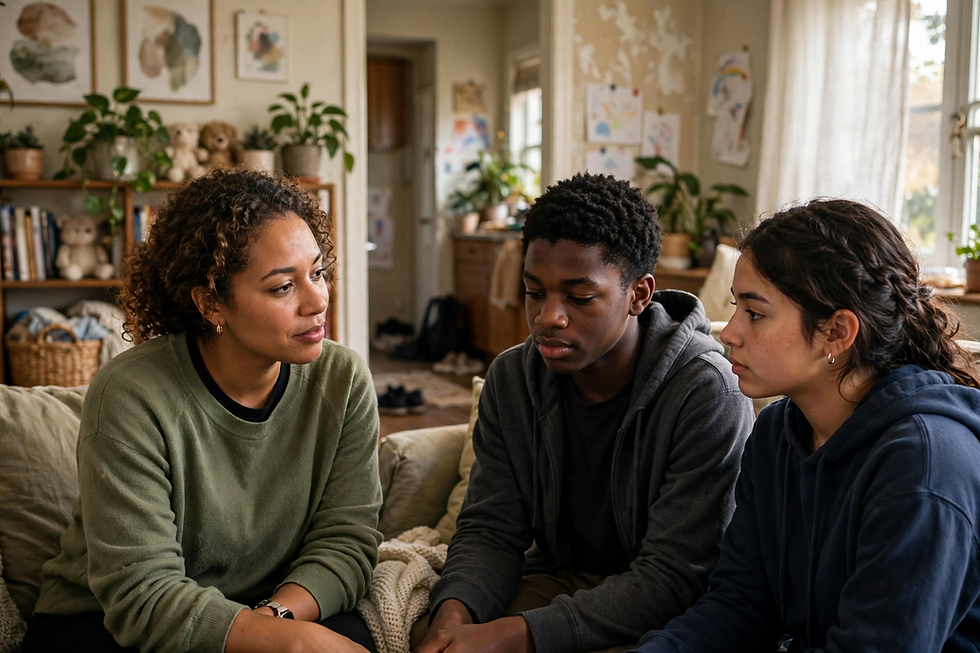
We hold to one standard: care that ends in real, observable change in a young person's behavior, attitude, and character development.
Our practice is grounded in the Core Principles of Strength-Based Practice, and we mean them literally:
-
Change is inevitable. Every person carries the urge to succeed, to explore the world around them, and to be useful to others and to their community.
-
What you focus on becomes reality. So we focus on strength, not labels.
-
Challenges are areas for growth. A difficulty is an opportunity that has not been worked yet, not evidence of a deficit.
-
Our mentoring builds on what is already working in a young person's life rather than cataloging what is not — and it asks the youth to become part of the change, not the object of it.

